Who Needs a Current State Technology Architecture?
post by Chris Curran on August 23, 2010 0
0
 0
0 0
0Guest Post by Zach Sachen, Sridhar Karimanal and Rima Safari
Collecting information about your current technology architecture is a major pain, so why bother? Is it just a waste of time or is it another enterprise architecture myth?
A quick calculation shows that building skills and processes to produce, maintain, and use current state architecture information can save a company a lot of time and money, as well as realize additional benefits along the way. Depending on the size of a company’s project portfolio and the use of the current state data across those projects a company can save millions annually.
Before we jump into the calculations, let’s dive a bit deeper and first take a look at the characteristics and benefits of a good current state technology architecture.
Characteristics of a Current State Technology Architecture
- Traceable: documents key relationships, interactions, dependencies that exist among systems, actors, and the underlying business functions which they support.
- Appropriate Data Model / Metadata: considers the wide-range of data available, but narrows down scope to those important and accessible attributes - e.g. application names, vendor products, application owner(s), technology protocols, business functions, and operating systems.
- Consistent Representation: uses a consistent / standard means of representing information to facilitate communication of common architecture information.
- Centralized and Reusable: accessible quickly and easily across organizations, enables enterprise transparency, and helps ensure freshness of information.
- Up To Date: Stale information is worth less.
Benefits of a Current State Technology Architecture
- Decision Making: enables a degree of predictive modeling to ensures that there are no hasty IT investments and/or acquisition activities, and facilitates impact assessment right from the beginning.
- Cost Modeling/Reduction: provides an enterprise-level fact-based understanding of the costs and benefits involved - e.g. for the current IT infrastructure this can help identify aging applications that are increasing support costs.
- Efficiencies: helps to identify waste as it contains the complete inventory of applications and their characteristics/functionality; it thereby acts as a catalyst for application rationalization opportunities.
- Architecture Governance: provides a basis for planning and adjusting architecture governance efforts ahead of time rather than reacting to unknowns that surface over time.
- Training: delivers faster on-boarding/learning for new employees through its information on how the business runs and the technology that supports it.
- Assessments: provides a fast way to conduct impact assessments from either a business process and/or technology perspective; examples include using it to provide a regulatory and compliance driven project baseline or using a it to drive technology-related health assessment.
- Operational Improvements: drives hypotheses development for operations improvement exercises.
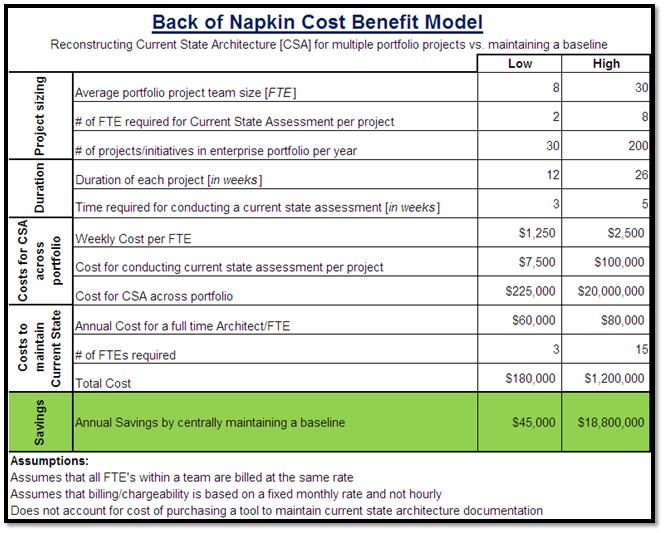
Now that we have looked at the characteristics and soft benefits of having the information let’s review the potential hard benefits/savings using some “back of napkin” calculations.Here’s a quick assessment that supports the range of savings asserted at the beginning of this article. The calculations below simply show a range of annual costs associated with not having current state technology architecture information for enterprise projects.
cc licensed flickr photo shared by Paul Stevenson
000
Pingback: How to Assess Your Technical Architecture — CIO Dashboard()
Pingback: How to Assess Your Technical Architecture()
Pingback: Current State Enterprise Architecture Analysis | Easy Architecture Fan()
Pingback: Cmdb Vs Enterprise Architecture | Easy Architecture Fan()
Pingback: Current State Of Architecture | Easy Architecture Fan()